
For business owners weighing a private equity partnership, the most reliable information rarely comes from a pitch deck. It comes from the people who have already lived through the deal, the first year, and everything after.
In this whitepaper, Guardian investment professionals, Chris Fugaro and Molly Borowski, have a discussion with business owners who partnered with Guardian as they embarked on the next wave of growth. Throughout this conversation we reflect on the decisions that have shaped their experiences. The founders and owners highlighted include: Bob Farinha, co-founder and CEO of Nügredient Solutions, a specialty nut-based ingredient manufacturer headquartered in Modesto, California; Erik Isernhagen, CEO of LINX, a leading technology infrastructure firm based in Denver, Colorado; Jim Russell, CEO of former Guardian portfolio company, R&D Altanova and now active board member of Guardian portfolio company, Heatscape, a Silicon Valley-based designer and manufacturer of custom thermal management solutions.
“The most credible version of the Guardian story isn’t ours to tell,” says Chris Fugaro, Partner at Guardian Capital Partners. “The founders and operators who have lived this partnership are the best evidence of what partnership looks like once the ink is dry.”
Their perspectives span industries and transaction structures, but the themes that emerge are consistent: the value of operational and strategic alignment, the importance of preparation, and what it really means to have a partner committed to building the business, not just buying it.
“The most credible version of the Guardian story isn’t ours to tell. The founders…who have lived this…are the best evidence of what partnership looks like…”
“When we evaluate a new investment, we’re asking very specific questions: do we have the knowledge and resources to improve this business, and is our strategic vision aligned with the management teams we are investing behind?” says Molly Borowski, Principal at Guardian Capital Partners. “If the answer isn’t clearly yes, that matters. The founders we back deserve a collaborative partner prepared and capable of making a positive impact.”
Bob Farinha, Co-Founder and CEO, Nügredient Solutions
Nügredient has evolved significantly since its founding. How would you describe the company today?
Farinha: We started in 2008 as an almond processing business rooted in the Central Valley, a grower-first model built on relationships with farmers and food manufacturers who needed consistent, traceable nut ingredients at scale. Over time, our customers started asking for more: formulation support, co-manufacturing capabilities, help developing new products. We expanded into seeds, butters, and flours, and other custom ingredient solutions, and in 2025 we renamed the company Nügredient Solutions to reflect that evolution. It wasn't a cosmetic rebrand. It was a message to the market about who we'd become.
Borowski: The Nügredient rebrand is a good example of what we look for before we invest, not after. Bob and his team had already made the strategic shift toward specialty ingredients well before the name changed; the rebrand was a market signal, not a pivot. That is the kind of business we want to back: one where the operators are already ahead of the market.
What was the inflection point that led you to explore a capital partner?
Farinha: It came down to the gap between the opportunity we could see and the speed at which we could pursue it on our own. We had strong customer relationships and a proven manufacturing operation, but we wanted a strategically-oriented partner to help us more expeditiously expand operations to capture market demand and accelerate growth. A lot of private equity groups come in with a financial narrative already written; they want to know if you fit the thesis. Guardian was different. They came in with a questions-first approach. They wanted to understand our processes, our customers and what was actually constraining our growth. That is a different kind of conversation, and it told me the partnership would be focused on building a better, more resilient business, not just optimizing the exit.
Borowski: Our approach starts with understanding how we can help accelerate growth, support the customer and supplier base, and unlock capacity constraints. The valuation conversation comes later, once we actually understand the business and the levers we can pull to bring value.
You retained equity and are continuing to lead the company. How do you think about the road ahead?
Farinha: My role does not change in the ways that matter. I am still responsible for the strategy, the team, and the customer and supplier relationships. What changes is the toolkit. Having Guardian and its operating partner wholly-owned affiliate Guardian Operations and Advisory Company (“GOAC”) alongside us as we expand our capabilities is a real advantage. I remain an equity owner and believe in the strategic vision for the business. The goal is a significantly larger, more capable company, built on the same values that got us here. Guardian's model of aligned interests makes that a shared objective, not just mine.
Borowski: Bob and his team have built an exceptional business founded on an unwavering commitment to quality and a deeply customer-centric culture. From our earliest conversations, it was evident that our vision for Nügredient's next phase of strategic growth was closely aligned with Bob's. That alignment, combined with the strength of the organization's capabilities, gives us tremendous confidence in Nügredient's ability to execute on its long-term growth strategy.
Erik Isernhagen, CEO, LINX
Tell us about LINX and what you were building.
Isernhagen: The market for technology integration was fragmented in a way that created real problems for clients. If you were building a data center or a mission-critical facility, you were managing separate contractors for network cabling, audio-visual, wireless, and security, and none of them talked to each other. We built LINX to bring all four disciplines under one roof with a consistent delivery standard. Since founding the company in 2003, we've completed more than 100,000 projects across all 50 states, representing over a billion dollars in value.
Fugaro: What Erik describes is exactly the kind of platform we look for in digital infrastructure. LINX didn't need us to tell it how to run field operations across fifty states; it needed a partner who could help prioritize strategic initiatives in order to scale overall operations including quality, process management, recruiting, training, and other key growth functions without diluting the delivery standard and culture that earned LINX its customer-centric positive reputation. That distinction matters more than people think.
What made you decide it was the right time to bring in a partner, and what led you to Guardian?
Isernhagen: The digital infrastructure investment cycle we're entering is a generational opportunity, and capturing it requires financial and operational support that would have taken years to build on our own. Most of the inbound outreach we received was generic; it was clear most groups hadn't done their homework. Guardian was different. They had already made two prior investments in digital infrastructure, so they understood our business before we sat down. They weren't asking what technology integration was; they were asking about our delivery model, our field operations, and where the real constraints on growth were. That kind of preparation tells you a lot about what a partnership will actually look like.
Fugaro: Erik's point about preparation isn't an accident. Before we ever sat down with LINX, our team had already underwritten two other digital infrastructure businesses, so we came in understanding unit economics, crew utilization, and where margin actually gets made or lost in this space. Founders can tell the difference between a group just kicking tires and doing initial diligence and a group that has already done the work.
What does success look like going forward?
Isernhagen: We are focused on bending the revenue curve: geographic expansion, additional service capabilities, and acquisitions that can accelerate the platform. Guardian’s operational support, GOAC, has been a real resource in helping us think through how to build the infrastructure to support growth without losing what made LINX what it is. The capital is the easier part. Making sure the culture and the delivery standard scaled with the company is the harder work.
Fugaro: The GOAC relationship Erik describes is deliberate, not a service we bolt on after closing. Our operating team spent time in the field with LINX's crews before making any recommendation about how to scale, because the operational discipline that built the business is the same discipline that has to scale with it.
Jim Russell, Board Member, Heatscape
Your relationship with Guardian goes back further than Heatscape. Can you give us some context?
Russell: I was CEO of a Guardian Fund I portfolio company, R&D Altanova, so I have seen the partnership from the inside, at an earlier stage of the firm's evolution, working through the same value creation levers Guardian applies today. When Heatscape came together as a Fund IV platform, Guardian asked if I would join the board. It was an easy yes. I know how Guardian operates. I know their commitment to hands-on collaboration is real, not a marketing line. And I had conviction in Heatscape's business. Coming in as a board member rather than an operating CEO is a different role, but the foundation of trust was already there.
Fugaro: Jim's history with the firm illustrates how we think about talent across the portfolio. Operators who have been inside a Guardian partnership carry judgment that is hard to replicate, and Jim moving from a CEO seat to a board seat is the kind of continuity we strive to build.
For readers who don't know Heatscape, what does the company do, and why is the timing compelling?
Russell: Heatscape designs and manufactures thermal management solutions for high-performance computing, infrastructure, telecom, and defense. The business is built on a simple premise: as electronic systems become more powerful, managing the heat they generate becomes a harder engineering problem, and getting it wrong is not a warranty issue, it is a system failure. The thermal requirements for next-generation AI accelerators are meaningfully more complex than prior generations, and that complexity is exactly where Heatscape excels.
Fugaro: Thermal management was a sector we underwrote carefully before Heatscape, so we understood the engineering and the economics before we sat down. The AI buildout was creating constraints most cooling providers couldn't solve, and Heatscape's depth in engineering put it ahead of that curve. But conviction in a sector isn't enough on its own. Heatscape needed a partner who could fund capacity against a generational demand curve and help scale up without breaking what works. That is what Guardian brought, and it's why the fit was right.
Having been a portfolio CEO and now a board member, what's the most useful thing you can offer the Heatscape team?
Russell: Pattern recognition. A first-time PE-backed CEO spends real energy trying to figure out what is normal: whether the level of reporting is typical, whether the value creation plan is structured the way these plans usually are, whether a given ask is reasonable. I can short-circuit a lot of that uncertainty. I can tell the Heatscape leadership team what Guardian genuinely cares about, where the partnership adds the most value, and how to get the most out of the GOAC relationship. That context is hard to get anywhere else. If I can help the team move faster and with more confidence because of it, that is the contribution I am here to make.
Fugaro: What Jim offers Heatscape is something we can't manufacture ourselves: the perspective of someone who has actually sat in the CEO chair inside a Guardian partnership. That is the value of the network we bring and it is a resource every company in our portfolio can draw on.
What the Guardian Partnership Looks Like in Practice.
Across these three companies, three industries, and three different roles, a consistent picture emerges of what distinguishes a Guardian partnership from a typical private equity transaction.
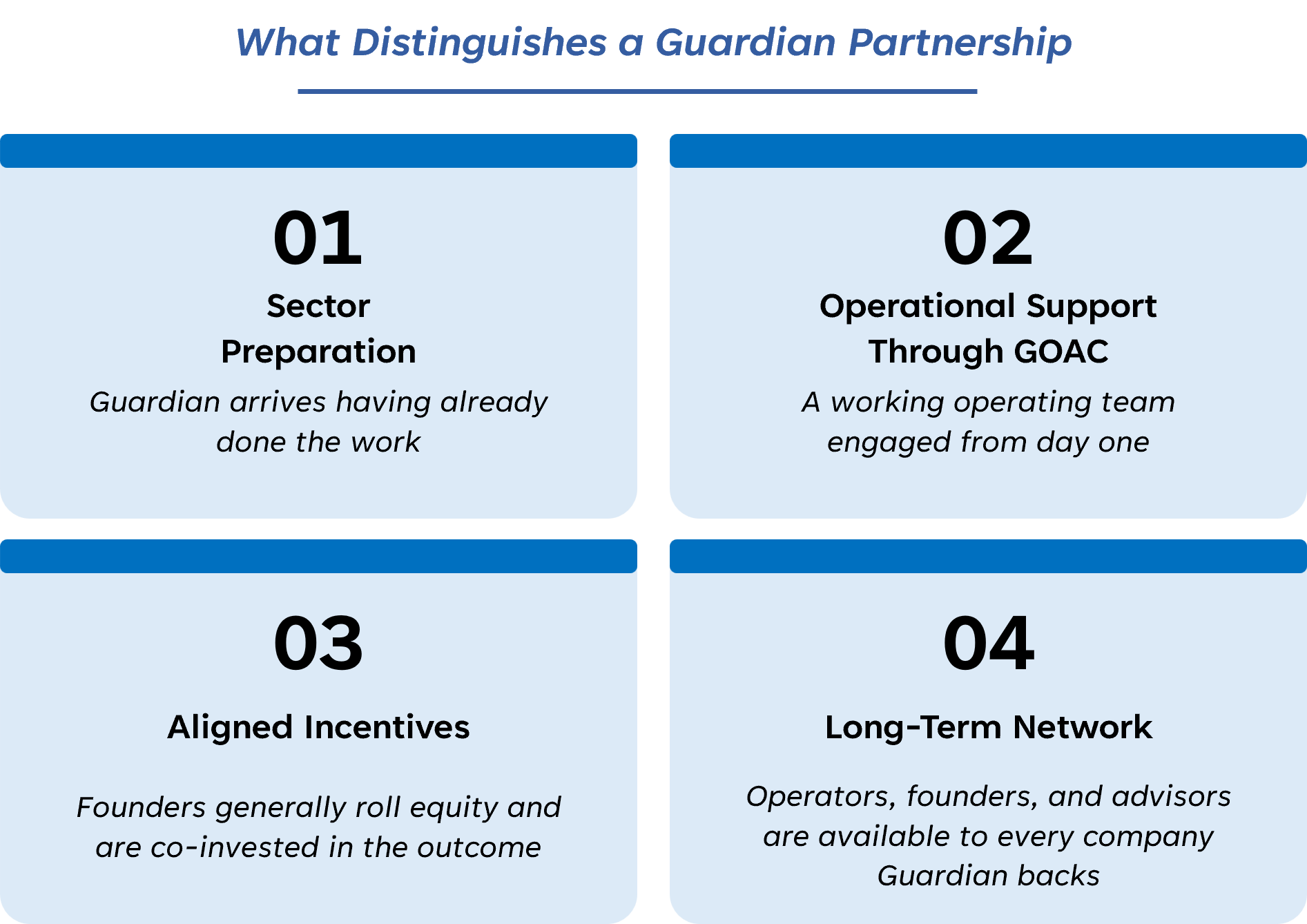
Sector preparation. Guardian invests in industries it knows. Whether in digital infrastructure, specialty ingredients, or thermal management, the firm arrives at the table having already done the work in its priority sectors. That changes the quality of every conversation that follows, from the first meeting through the life of the partnership.
Operational support through GOAC. The Guardian Operations and Advisory Company is not a brochure item. It is a working team of operating professionals who engage directly with portfolio management teams on the challenges that determine whether a growth plan succeeds or stalls. Every company in Guardian's portfolio has access to this resource.
Aligned incentives. Guardian structures its partnerships so that founders who roll equity into the next phase are genuinely co-invested in the outcome. The goal is a larger, more capable business, and that shared incentive shapes how decisions get made throughout the relationship.
A long-term network. Guardian builds and maintains a network of operators, founders, advisors, and Mountain Guides with firsthand experience inside the portfolio, and that network is available to every company Guardian backs.
“What I take from these stories is straightforward,” Borowski says. “The founders who build the most with a Guardian partnership are the ones who had a vision for the business. Our job is to remove the obstacles between where they are and where they want to go. That’s what GOAC does, that’s what our sector expertise is for, and it’s why we structure our deals the way we do.”
Contact Guardian
To learn more about how a partnership with Guardian Capital Partners could benefit your business, please contact Chris Fugaro, Partner and Head of Business Development, at cfugaro@guardiancp.com or (610) 263-0102.
This paper is for informational purposes only, is intended solely for parties seeking capital for a potential transaction, and is not a solicitation to invest in any limited partnership managed by Guardian Capital Partners which can only be made through a private offering. Any opinion expressed is that of Guardian Capital Partners and those interviewed as of the date indicated, is subject to change without notice, and is not a guarantee of future performance. Such statements are being offered as references for purposes of demonstrating the benefits of working with Guardian Capital Partners. No executives were paid for their participation in this whitepaper. Nothing herein should be construed as investment advice. This is not considered an advertisement of the advisory services of Guardian Capital Partners or an offer to provide new advisory services.