
Artificial intelligence, cloud computing, increasing connectivity demands, and the continued digitization and electrification of the global economy are driving substantial investment across digital and physical infrastructure alike. Sustaining that growth depends on the physical foundations beneath it: power availability, thermal management, connectivity, deployment execution, and the modernization of increasingly critical infrastructure environments.
Guardian Capital Partners (“Guardian”) (www.guardiancp.com) has spent more than a decade investing behind the businesses that power, connect, and maintain these mission-critical environments, including:
- Voltz by Raptor Power Systems: Designer and manufacturer of engineered power distribution solutions
- Heatscape: Advanced thermal management solutions supporting computing and electronics applications
- LINX: Technology services for data center and mission-critical environments
- Direct Line Global (CBRE): Data center IT infrastructure and connectivity services
- CIS Global (nVent): Manufacturer of rack mount technologies, linear motion products, and power distribution solutions
Through these investments Guardian has developed a differentiated perspective on how critical infrastructure businesses are optimally built, scaled, and operationalized over time.
In the following conversation, Scott Evans and Damien Gresko discuss the evolution of the market, lessons learned across prior investments, and why Guardian believes the opportunity set across infrastructure modernization, electrification and technical infrastructure services remains substantial and highly compelling.
Damien Gresko: One of the interesting dynamics in today’s environment is that many investors now talk about digital infrastructure almost exclusively through the lens of AI or hyperscale data centers. But our experience in the space started well before the current AI cycle and has often been much more connected to physical infrastructure supporting digital growth and broader infrastructure modernization.
Scott Evans: That’s right. Long before AI became the dominant narrative, we invested in businesses supporting the underlying infrastructure requirements created by increasing data consumption, uptime expectations, and power demands.
One of our initial investments in this sector, CIS Global, acquired by Guardian in 2015, gave us an early look into how rapidly growing digital workloads translated into real-world demand for power distribution and infrastructure hardware. What stood out was that reliability mattered just as much as innovation. Power to the rack was getting smarter and customers were building environments where downtime and power management inefficiency simply were not acceptable, which created very high expectations around engineering quality, manufacturing execution, delivery consistency, and responsiveness. CIS Global marked Guardian’s entry point into the sector and shaped our conviction that these are, ultimately, essential infrastructure businesses with substantial long-term potential.
“Long before AI became the dominant narrative, we invested in businesses supporting the underlying infrastructure requirements”
“Long before AI became the dominant narrative, we invested in businesses supporting the underlying infrastructure requirements”
Damien Gresko: The phrase “critical and essential” feels overused within the private equity community, but both are true and relevant here. The operational execution theme became even more apparent as Guardian expanded into services and field-based infrastructure businesses. With Direct Line Global, acquired by Guardian in 2018, we saw firsthand that the infrastructure itself is only part of the equation. The ability to consistently deploy, maintain, and scale across geographies became equally important.
What we’ve come to appreciate is that many of these businesses sit at the convergence of engineering, technical capability, operational execution, and infrastructure reliability. That combination creates tremendous opportunity, but it also makes these businesses genuinely difficult to scale and to invest in well. Those that get it right, however, can build a durable and defensible advantage.
Scott Evans: Absolutely. Direct Line Global reinforced how operationally demanding these environments can become at scale. Execution often becomes the true differentiator.
Expectations around project management, workforce coordination, scheduling discipline, deployment speed, safety and quality assurance, and execution consistency continue to rise. Many of the businesses operating in these markets are highly technical and deeply customer-oriented but woefully underbuilt from an operations perspective relative to the scale of the opportunity in front of them. Helping owners and operators evolve from entrepreneurial success into scalable, leading, institutional platforms is central to our mission. Across multiple investments, we have helped businesses grow meaningfully in both size and sophistication while supporting increasingly demanding customer environments.
Damien Gresko: That operational maturity point is important because many of the best businesses in the sector were successfully built by highly entrepreneurial operators, but “what got you here may not get you there” often rings true. Moving from niche or local leadership to extending across the map and doubling output and/or the workforce in a matter of months drives a tremendous amount of change. Keeping pace with that kind of growth requires a different level of operational expertise and capabilities.
We’ve seen that organizations require a different mindset in order to scale up to support the next wave of growth - whether that involves expanding manufacturing capacity, strengthening engineering capabilities, building technical recruiting and workforce development infrastructure, improving program management, or supporting more complex customer deployment requirements.
Scott Evans: We often talk internally about playbooks, professionalization, and “building the infrastructure behind the infrastructure.” That can mean implementing systems and processes, strengthening leadership teams, improving visibility into execution and utilization, or helping management teams scale operational planning capabilities.
Importantly, that work is rarely about changing what made a business successful in the first place. The objective is to preserve the winning culture, technical strengths, and customer relationships that drove early success while building the foundation required to support resilient long-term growth.
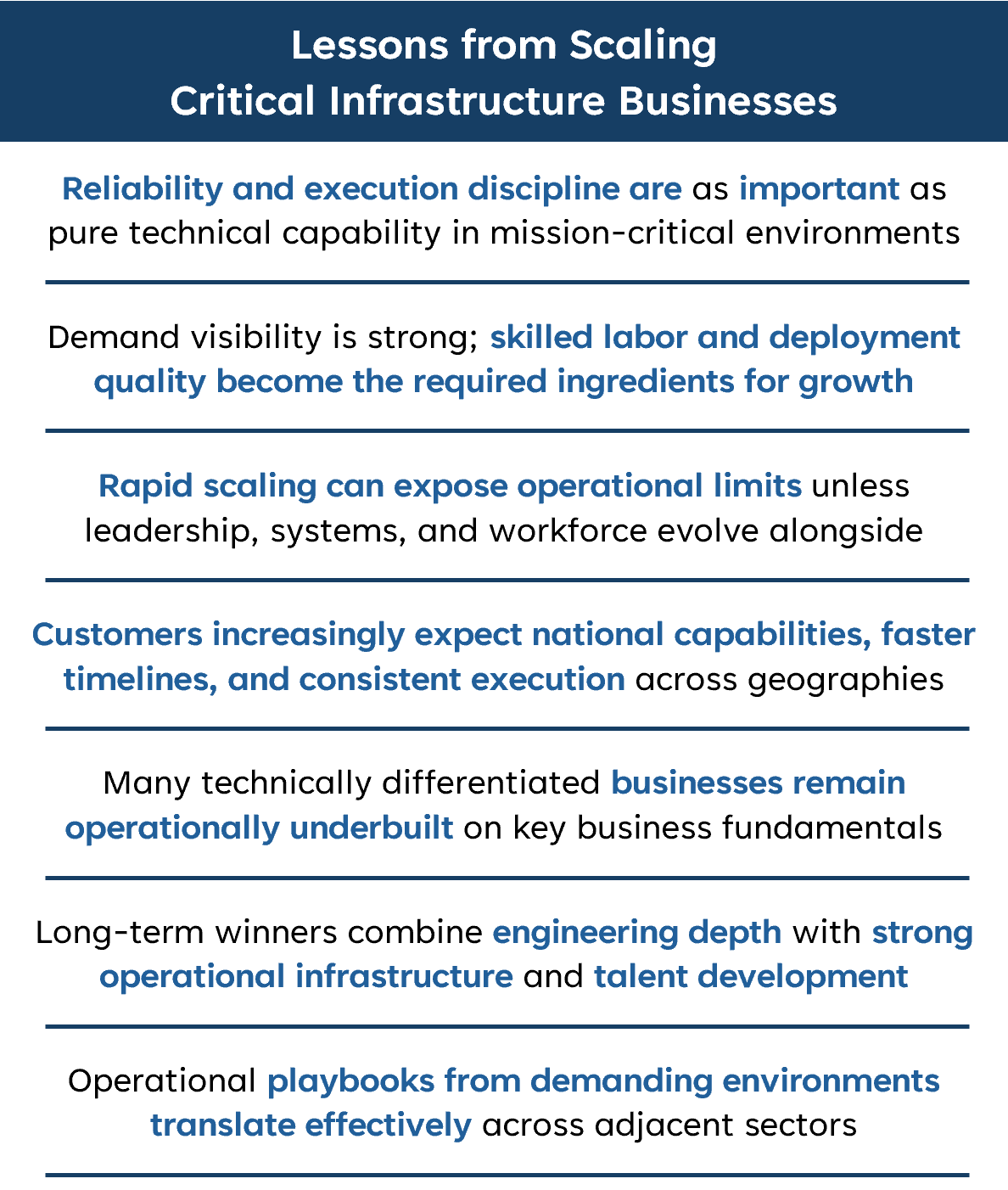
Damien Gresko: Talent has emerged as a recurring theme, and for good reason. People and culture matter, from the executive suite through delivery in the field or facility. In many areas of critical infrastructure, workforce quality and labor availability are becoming strategic constraints on growth.
Scott Evans: Recruiting, training, retaining, and developing skilled technical labor has become one of the defining operational challenges across the sector.
We view workforce strategy as a core operational priority rather than a secondary HR issue. Businesses that invest meaningfully in training, safety, culture, leadership development, and employee engagement are often much better positioned to scale successfully over time.
Damien Gresko: Given that we have been investing in the space for over a decade, we have extensive experience across a variety of infrastructure environments, customer demands, scaling challenges and operational scenarios, and that pattern recognition compounds.
This experience has not only sharpened our infrastructure investing capabilities but has also informed how we approach operational improvement and growth across other industrial and technical service investments throughout the rest of the portfolio.
Scott Evans: Every investment has taught us something, and we carry those lessons forward into the current portfolio.
With LINX, acquired in 2024, we saw a technically strong infrastructure services business supporting connectivity, security, wireless infrastructure, and mission-critical network environments. As customer requirements increased materially, the opportunity became less about simply adding volume and more about building the operational systems, leadership infrastructure, recruiting capabilities, and execution discipline necessary to support larger and increasingly sophisticated deployments.
Similarly, with Voltz by Raptor Power Systems, acquired in 2025, we are supporting a business operating in an environment where power reliability and deployment certainty are increasingly valuable. A solutions-oriented culture paired with innovative engineering expertise has enabled investments in quality production capacity, key talent acquisition and development, and a more expansive portfolio to serve its customers.
And with Heatscape, acquired in 2025, we are investing behind thermal management solutions that address rising compute density and cooling requirements tied not only to AI and high-performance computing environments but other critical industries including medical and aerospace and defense, among others.
While the underlying products, services, and operating models differ meaningfully across those businesses, the broader themes remain remarkably consistent: increasing infrastructure complexity, rising reliability expectations, growing customer sophistication, and the critical importance of operational execution.
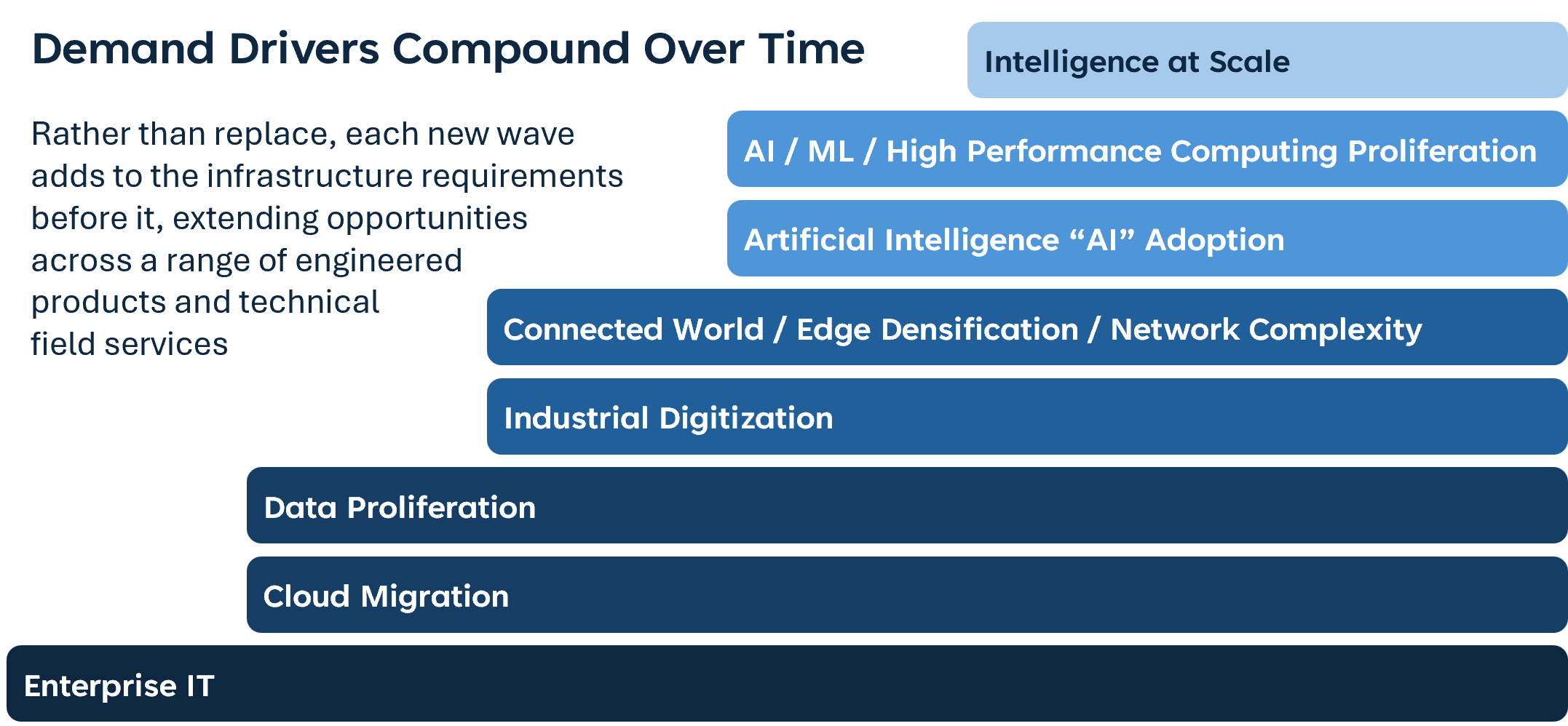
Damien Gresko: Beyond the businesses we have partnered with over the years, we have invested through a number of eras defining the digital infrastructure landscape. These forces have compounded and, in our view, they have only expanded the overarching market potential.
Importantly, the opportunity set extends well beyond traditional definitions of data center infrastructure. We believe the continued digitization and electrification of the economy will require substantial ongoing investment across power, grid modernization, connectivity systems, and broader infrastructure modernization initiatives.
Scott Evans: We view these themes as some of the most attractive and strategically important areas within the broader industrial landscape, and we remain highly active in identifying and evaluating new investments in these and related spaces.
Our experience spans both engineered products and technical services, and we understand where operational complications and execution risk tend to emerge as businesses scale. We work closely with founders and management teams to help strengthen operational infrastructure, support expansion initiatives, develop workforce capabilities, pursue strategic acquisitions, and build durable organizations capable of supporting increasingly sophisticated customer environments. That’s where we think Guardian does its best work.
Damien Gresko: What continues to excite us is that the market is not only large but evolving quickly. We think that creates a compelling environment for experienced, operationally oriented investors to support businesses and their teams in solving problems, capitalizing on opportunities, and building something that lasts.
About Guardian
Guardian (www.guardiancp.com) is an operationally focused private equity firm based in suburban Philadelphia that makes control investments in lower middle market companies. As a thematic investor, Guardian pursues opportunities through its proprietary Guardian Priority Sectors Program, a thesis-driven strategy that channels the firm's focus, expertise, and relationships toward specific sectors of interest. The firm partners with management teams to provide equity capital supporting the growth of privately held businesses, drawing on a unique combination of hands-on operational and transactional experience to help deliver execution and long-term value creation for its portfolio companies. Since its founding in 2008, Guardian has completed more than 80 transactions representing over $3.7 billion in total enterprise value (as of March 31, 2026).
To learn more about Guardian Capital Partners or discuss opportunities within digital infrastructure and related sectors, please contact Chris Fugaro, Partner and Head of Business Development, at cfugaro@guardiancp.com or (610) 263-0102.
This paper is for informational purposes only. The information provided herein includes opinions and strategic approaches concerning value creation. Any opinion expressed is that of Guardian Capital Partners as of the date indicated, is subject to change without notice and not a guarantee of future performance.
Nothing herein should be construed as investment advice. This is not considered an advertisement of the advisory services of Guardian Capital Partners or an offer to provide new advisory services.
Certain statements contained herein constitute forward-looking statements, including statements regarding market conditions, investment opportunities, and the future activities of Guardian Capital Partners. These statements are based on current expectations and assumptions and involve known and unknown risks, uncertainties, and other factors that could cause actual results to differ materially from those expressed or implied. Guardian Capital Partners makes no representation or warranty as to the accuracy or completeness of the information contained herein, and assumes no obligation to update any forward-looking statements.